
Home › Models › BYD SEALION 7 › Powertrain
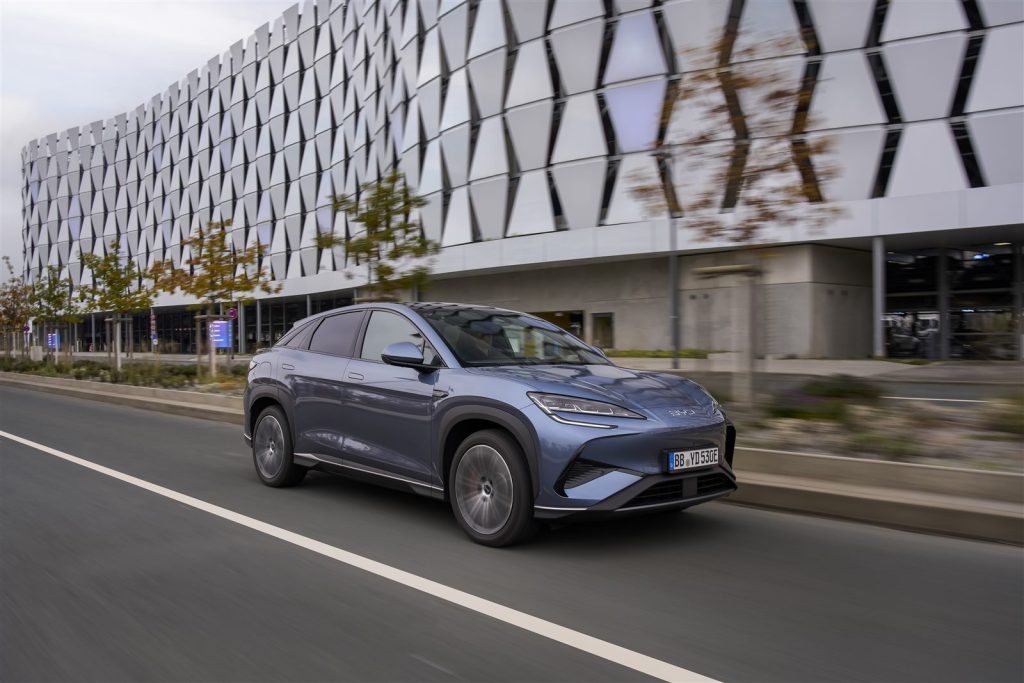
This page provides an independent guide to the powertrain, battery specifications, and structural parameters of the BYD SEALION 7 in the Australian market. Please note that trim names, specifications and prices reflect a compiled dataset (October 2026) and that BYD Automotive Australia may update variants, so every figure must be confirmed with an authorised BYD dealer or the official BYD Australia website. Official service/warranty page: https://bydautomotive.com.au/service-and-warranty
The BYD SEALION 7 operates exclusively as a pure electric vehicle (BEV). It contains no petrol engine, no exhaust system, no spark plugs, and requires no engine oil. It is powered solely by electric motors drawing current from a high-voltage battery. There are no internal combustion components, and any mechanical service is strictly subject to manufacturer specifications.
Contents
- Architecture and Powertrain Layout
- Motor Specifications and Performance
- Battery Capacity and Range
- Charging System and Capabilities
- Dimensions, Weights and Chassis
- Fuel, Gas Modifications and Warranty
- Powertrain Maintenance and Safety
- Frequently Asked Questions
- See Also
- Sources
Architecture and Powertrain Layout
The structural foundation of the BYD SEALION 7 is built on the BYD e-Platform 3.0 Evo architecture, specifically designed for electric vehicles. A central element of this design is the Cell-to-Body (CTB) battery integration system, which incorporates the high-voltage battery pack directly into the vehicle’s structural frame.
The manufacturer describes the drive unit as an 8-in-1 electric powertrain. This integrated approach consolidates various high-voltage components and control modules into a single assembly. Because the vehicle does not utilise traditional combustion powertrain components, maintenance and inspection routines differ significantly from those of legacy vehicles. For definitive guidance on the operation of these integrated systems, owners must refer to the official owner’s manual.
Motor Specifications and Performance
In Australia, the model is offered in two distinct powertrain configurations: the Premium variant and the Performance variant. The output and layout differ considerably between the two trims.
- Premium Variant: Features a rear-wheel drive layout, propelled by a single permanent magnet synchronous rear motor. This unit produces a maximum power of 230 kW and generates a maximum torque of 380 Nm. In this configuration, the vehicle achieves a 0-100 km/h acceleration time of 6.7 s.
- Performance Variant: Utilises an all-wheel drive layout. It retains the same permanent magnet synchronous rear motor (230 kW and 380 Nm) but adds a squirrel cage induction asynchronous front motor. The front motor delivers an additional 160 kW of power and 310 Nm of torque. Working together, the dual motor setup provides a combined maximum power of 390 kW and a combined maximum torque of 690 Nm. The increased traction and output allow it to complete the 0-100 km/h sprint in 4.5 s.
Battery Capacity and Range
Energy storage for both the Premium and Performance variants is handled by a BYD Blade Battery. The total energy capacity is 82.56 kWh. The battery pack supplies power to the motors and the automatic dual-zone heat pump air-conditioning system.
The vehicle’s driving range varies depending on the powertrain hardware and testing standard.
- The single rear motor Premium variant achieves a WLTP range of 482 km, while its NEDC testing figure is rated at 567 km.
- The dual motor Performance variant offers a WLTP range of 456 km and an NEDC figure of 542 km.
Range estimation is managed by the vehicle’s onboard computers, and factors such as ambient weather conditions, driving style, and accessory usage will influence the final distance achievable on a single charge. The manufacturer notes that fully charging the battery via an AC source every three to six months assists the software in accurately calculating the remaining range.
Charging System and Capabilities
The BYD SEALION 7 supports both alternating current (AC) and direct current (DC) charging methods. For standard AC charging, the vehicle uses a Type 2 AC charging port with a maximum input rate of 11 kW. For faster energy replenishment at public fast charging stations, the vehicle is equipped with a CCS 2 DC charging port, which can accept direct current at rates up to 150 kW.
A portable charging cable (mode 2) is supplied with the vehicle. Furthermore, the electrical architecture includes a Vehicle-to-Load (V2L) function. Using the supplied V2L discharge adapter, the high-voltage battery can supply power to external appliances and electrical devices. The powertrain also employs regenerative braking to capture kinetic energy during deceleration and return it to the battery pack.
Dimensions, Weights and Chassis
The exterior dimensions and capacities of the BYD SEALION 7 are identical across both variants:
- Length: 4,830 mm
- Width: 1,925 mm
- Height: 1,620 mm
- Wheelbase: 2,930 mm
- Front and Rear Wheel Track: 1,660 mm
- Minimum Turning Radius: 5.85 m
- Front Trunk Capacity: 58 L
- Rear Trunk Capacity: 500 L
- Seating Capacity: 5 occupants
Weight specifications differ based on the powertrain hardware. The Premium model has a kerb weight of 2,225 kg and a gross vehicle mass of 2,635 kg. The Performance model carries a kerb weight of 2,340 kg and a gross vehicle mass of 2,750 kg. Towing capacity details are not provided in the primary specification documents; owners must confirm with BYD Automotive Australia before attempting to fit a tow bar.
The suspension layout consists of a double wishbone front suspension and a multi-link rear suspension. Both axles utilise Frequency Selective Damping (FSD) shock absorbers. The braking system incorporates ventilated and drilled front discs alongside ventilated rear discs, with the Performance variant adding painted front brake calipers. Wheel and tyre packages range from 235/50 R19 or 255/45 R19 on the Premium to 245/45 R20 on the Performance. For correct wheel alignment and tracking specs in Australia, owners should consult an authorised BYD dealer.
Fuel, Gas Modifications and Warranty
The BYD SEALION 7 runs entirely on electricity. The brand does not offer, support, or authorise LPG, CNG, or autogas conversions. Any aftermarket gas conversion or unauthorised modification to the vehicle’s structural or electrical components automatically voids the factory warranty.
The vehicle is supplied with a 6 year / 150,000 km new vehicle warranty. The high-voltage traction battery and the drive unit (which includes the drive motor and drive motor controller) are backed by an 8 year / 160,000 km warranty. This coverage includes a guarantee of at least 70% battery capacity retention over that period. This coverage is strictly contingent upon adhering to the proper operating and charging practices outlined by the manufacturer. If the vehicle is unused for extended periods, the battery must be maintained at a 40%-60% state of charge.
Powertrain Maintenance and Safety
Scheduled maintenance for the BYD SEALION 7 is required every 20,000 km or 12 months, whichever comes first. Routine servicing for the electric powertrain involves specific tasks, including replacing the brake fluid and replacing the e-motor controller coolant. The exact schedule is subject to manufacturer specifications based on the vehicle’s operating conditions.
Working on high-voltage systems carries severe risks. Owners must never touch, alter, or open the high-voltage orange cables routed throughout the vehicle. Any maintenance, repairs, or diagnostics concerning the battery pack, drive motors, power electronics, or charging hardware must be conducted by an authorised BYD dealer or qualified technician. To ensure continued safety and strict warranty compliance, always consult an authorised BYD dealer before authorising any mechanical or electrical repairs.
Frequently Asked Questions
What is the maximum DC charging rate for the BYD SEALION 7?
The vehicle is equipped with a CCS 2 DC charging port that accepts a maximum charging rate of 150 kW.
Does the all-wheel drive Performance variant have a larger battery?
No, both the Premium and Performance variants are equipped with the identical 82.56 kWh BYD Blade Battery.
Where should I store the portable AC charging cable?
The vehicle features a 58 L front trunk that provides suitable storage for the portable charging cable and the V2L discharge adapter.
What is the 0-100 km/h acceleration time for the BYD SEALION 7 Performance?
The all-wheel drive Performance variant achieves a 0-100 km/h acceleration time of 4.5 s, while the single motor Premium variant takes 6.7 s.
Does the BYD SEALION 7 have a Vehicle-to-Load (V2L) function?
Yes, the vehicle features a Vehicle-to-Load (V2L) function and includes a V2L discharge adapter to supply power to external electrical devices.
See Also
- BYD SEALION 7 Review & Overview
- BYD SEALION 7 Pricing & Purchase Guide
- BYD SEALION 7 Warranty & Documentation
- BYD SEALION 7 Logbook Servicing Guide
- BYD SEALION 7 Battery & Charging System
- BYD SEALION 7 Electric Drive Unit
Sources
- https://bydautomotive.com.au/sealion-7
- https://bydautomotive.com.au/brochures/BYD-SEALION-7-2026.pdf
- https://bydautomotive.com.au/service-and-warranty
- https://bydautomotive.com.au/public/vehicle-warranty-2026.pdf
Disclaimer: This guide is for informational purposes only. Official specifications, recall details, and warranty terms are determined by BYD Automotive Australia (EVDirect). Always consult an authorized dealer or official owner’s manual.