
Home › Models › BYD ATTO 3 › Powertrain
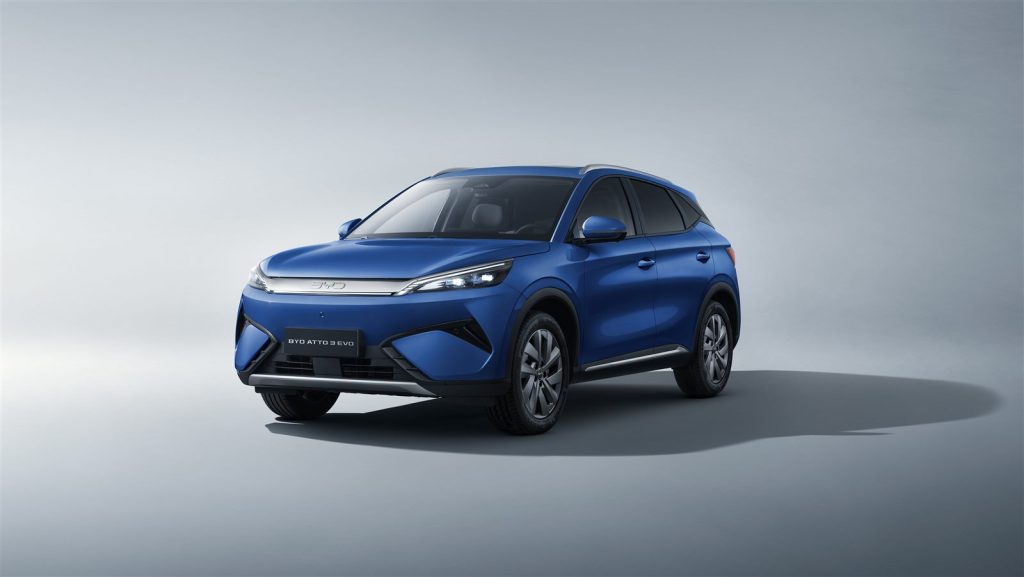
This guide details the electric powertrain and energy specifications for the BYD ATTO 3 in Australia. The BYD ATTO 3 is a pure electric vehicle (BEV). It runs exclusively on electricity and features a 100 per cent electric drivetrain engineered upon the BYD e-Platform 3.0 and e-Platform 3.0 Evo with Cell-to-Body (CTB) battery integration. It has no petrol engine, no exhaust, no spark plugs, and no engine oil. Furthermore, BYD does not offer or authorise LPG, CNG, or autogas conversions for this model, and any aftermarket gas conversion voids the factory warranty.
Please note that trim names, specifications and prices reflect a compiled dataset (October 2026) and that BYD Automotive Australia may update variants, so every figure must be confirmed with an authorised BYD dealer or the official BYD Australia website. For official warranty terms and maintenance schedules, please visit the official service and warranty page: https://bydautomotive.com.au/service-and-warranty. This is an independent guide; for specific technical concerns, confirm with BYD Automotive Australia.
Contents
- Electric Motor Specifications
- Battery Capacity and Range
- Charging Hardware and Vehicle-to-Load
- Chassis Dimensions and Powertrain Loads
- Battery Management and Care
- System Maintenance and High-Voltage Safety
- Frequently Asked Questions
- See Also
- Sources
Electric Motor Specifications
The BYD ATTO 3 employs permanent magnet synchronous motors inside an 8-in-1 electric powertrain. As a pure electric model, it relies solely on these motors for propulsion, with electronic stability control and hill descent control integrated into the driving dynamics. The standard ATTO 3 Essential and Premium variants, along with the ATTO 3 EVO Dynamic, are front-wheel drive. The BYD Atto 3 150kW electric drive motor performance in these specific configurations delivers 150 kW of power and 310 Nm of torque. The standard ATTO 3 Essential reaches 0-100 km/h in 7.9 seconds, while the standard ATTO 3 Premium and EVO Dynamic models reach 0-100 km/h in 7.3 seconds. The top speed for the EVO Dynamic is 160 km/h.
The BYD ATTO 3 EVO Premium variant features a 230 kW motor outputting 380 Nm of torque. It accelerates from 0-100 km/h in 5.5 seconds and has a top speed of 180 km/h. All models employ regenerative braking to capture energy while decelerating, and the EVO series provides selectable Standard and High regenerative braking modes. Drivers can choose between Eco, Normal, and Sport drive modes. In the event of a suspected physical vibration or noise, an inspection such as a BYD Atto 3 motor mount vibration check must be completed by a qualified technician, and owners should refer to the official owner’s manual for guidance.
Battery Capacity and Range
Energy is stored in the BYD Blade Battery, which uses lithium iron phosphate (LFP) chemistry. The total capacity and resulting range differ by variant.
When comparing the standard and extended range variants of the BYD ATTO 3, the Essential utilises a 49.92 kWh battery. This yields an NEDC range of 410 km and the WLTP driving range in Australia is rated at 345 km. The ATTO 3 Premium features a 60.48 kWh battery, providing an NEDC range of 480 km and a WLTP range of 420 km.
The EVO models feature different electrical architectures. The EVO Dynamic operates on a 400 V system with a 60.48 kWh battery, delivering a WLTP range of 420 km and consuming 16.0 kWh/100 km. The EVO Premium employs an 800 V architecture with a 74.88 kWh battery, delivering a WLTP range of 510 km and an energy consumption of 16.4 kWh/100 km.
Charging Hardware and Vehicle-to-Load
The BYD ATTO 3 charging system is compatible with AC Type 2 and DC CCS 2 connections, and it is supplied with a mode 2 portable charging cable. For those using a home wallbox charger, the AC charging capacity is 7 kW for the EVO Dynamic and 11 kW for the EVO Premium.
DC fast charging speeds vary. The ATTO 3 Essential accepts up to 70 kW, while the standard Premium variant supports a maximum DC fast charging speed via the CCS2 port of 88 kW. The EVO series supports higher charging rates: the EVO Dynamic accepts up to 110 kW (achieving 0-80% in 41 minutes), and the EVO Premium handles up to 220 kW (achieving 0-80% in 30 minutes).
All variants feature Vehicle-to-Load (V2L) technology. The V2L vehicle-to-load system has a power output of 3.3 kW. It uses a V2L discharge adapter to power external appliances. If you need a charging port lock release, do not attempt a manual override; instead, owners must consult an authorised BYD dealer.
Chassis Dimensions and Powertrain Loads
The electric powertrain is engineered to move the specific kerb weights and dimensional footprints of the lineup. The ATTO 3 has an overall length of 4,455 mm, a width of 1,875 mm, and a height of 1,615 mm, with a wheelbase of 2,720 mm. The ATTO 3 Essential has a kerb weight of 1,680 kg and a gross vehicle mass of 2,090 kg, supported by MacPherson strut front and multi-link rear suspension with 215/60 R17 tyres. The ATTO 3 Premium increases to 235/50 R18 tyres, weighing 1,750 kg with a gross vehicle mass of 2,160 kg. For both standard variants, the maximum towing capacity is 750 kg unbraked and 750 kg braked.
The ATTO 3 EVO Dynamic weighs 1,750 kg with a gross vehicle mass of 2,160 kg and a payload of 410 kg, maintaining the 750 kg braked and unbraked towing limits. The ATTO 3 EVO Premium weighs 1,880 kg, has a gross vehicle mass of 2,410 kg, and carries a 530 kg payload on Continental EcoContact 6 Q 235/50 R18 V XL tyres. The 230 kW motor setup allows the EVO Premium to tow up to 1,500 kg braked. Towing heavy loads places extra stress on the electric drive unit and is subject to manufacturer specifications.
Battery Management and Care
To minimise degradation and extend the lifespan of the Blade battery over time, the manufacturer provides clear maintenance directions. It is recommended to fully charge the vehicle at least once a week. Fully charging from below 10% via AC connection every three to six months helps the battery management system maintain accurate range estimations. In environments below 10 degrees Celsius, it is advised to charge immediately after driving while the battery is warm.
If parked unused for more than seven days, the battery state of charge should be maintained between 40% and 60%. If unused for more than three months, it must be fully charged and then discharged to the 40%-60% range every three months. Owners must recharge promptly if the state of charge hits 0%, because damage from a fully depleted battery is excluded from the warranty. A formal state of health (SOH) battery check should always be directed to an authorised service centre.
System Maintenance and High-Voltage Safety
Routine maintenance services are due at intervals of 20,000 km or 12 months, 40,000 km or 24 months, and so forth. Items recorded in the handbook service record for the EV series include replacing the brake fluid and the e-motor controller coolant. Under severe operating conditions, these intervals may need to be shortened, and owners should refer to the official owner’s manual for further guidance.
Because this is a pure electric vehicle, the powertrain contains dangerous high-voltage electrical energy. High-voltage orange cables, the traction battery enclosure, and electric motor control units must not be touched, modified, or opened by owners. All diagnostic work, including steering calibration or testing the front motor traction control systems, must be completed by an authorised BYD dealer or qualified technician.
Frequently Asked Questions
What is the WLTP driving range for the BYD ATTO 3 in Australia?
The WLTP driving range varies by model, offering 345 km on the standard Essential variant and up to 510 km on the EVO Premium. Confirm actual performance under different conditions with BYD Automotive Australia.
How do I manually override the charging port lock?
If the charging port lock fails to release, do not force it or attempt a manual override. You must consult an authorised BYD dealer to have the system safely checked and released.
How is a battery state of health (SOH) check performed?
A formal battery state of health assessment requires specialised diagnostic software. For an accurate reading and to ensure warranty compliance, the vehicle must be taken to an authorised BYD dealer.
What is the maximum vehicle-to-load (V2L) power output?
The maximum capacity of the Vehicle-to-Load system is 3.3 kW. This is accessed via the V2L discharge adapter, allowing the high-voltage battery to safely supply electricity to external equipment.
Are there any user-serviceable parts in the high-voltage electrical system?
No. High-voltage orange cables, battery packs, and electric drive motor units present a severe safety hazard and must never be accessed or opened by owners.
See Also
- BYD ATTO 3 Review & Overview
- BYD ATTO 3 Pricing & Purchase Guide
- BYD ATTO 3 Warranty & Documentation
- BYD ATTO 3 Powertrain & Fuel Specifications
- BYD ATTO 3 Battery & Charging System
- BYD ATTO 3 Electric Drive Unit
Sources
- https://bydautomotive.com.au/atto-3
- https://bydautomotive.com.au/brochures/BYD-ATTO-3-EVO.pdf
- https://bydautomotive.com.au/service-and-warranty
- https://bydautomotive.com.au/public/vehicle-warranty-2026.pdf
Disclaimer: This guide is for informational purposes only. Official specifications, recall details, and warranty terms are determined by BYD Automotive Australia (EVDirect). Always consult an authorized dealer or official owner’s manual.