
Home › Models › BYD SEAL › Powertrain
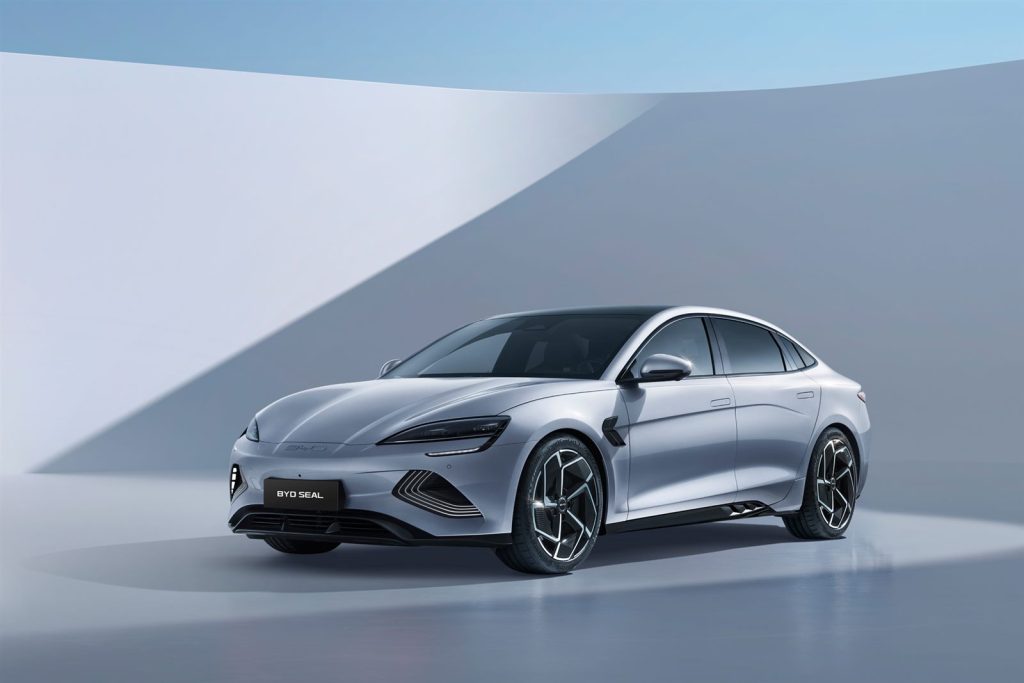
Welcome to the independent guide on the BYD SEAL powertrain and fuel specifications. This resource provides a detailed look at the electric drive components, battery systems, and vehicle dynamics found in the Australian BYD SEAL lineup. Please note that trim names, specifications, and prices reflect a compiled dataset (October 2026) and that BYD Automotive Australia may update variants, so every figure must be confirmed with an authorised BYD dealer or the official BYD Australia website.
The BYD SEAL is a pure electric vehicle (BEV) and operates entirely without traditional internal combustion components. This model runs only on electricity. It has NO petrol engine, NO exhaust, NO spark plugs, and NO engine oil. Furthermore, BYD does not offer or authorise LPG, CNG, or autogas conversions, and aftermarket gas conversion voids the factory warranty. For all servicing requirements or technical inquiries, always consult an authorised BYD dealer.
Contents
- Pure Electric Powertrain Architecture
- Motor Specifications and Outputs
- Battery Specifications and Driving Range
- Charging Capabilities and Vehicle-to-Load
- Chassis, Suspension and Dimensions
- High-Voltage Safety and Servicing
- Frequently Asked Questions
- See Also
- Sources
Pure Electric Powertrain Architecture
The BYD SEAL is built exclusively as a pure electric vehicle (BEV). Its propulsion system relies entirely on the high-voltage battery and electric motors. Because there are no internal combustion components, owners do not need to replace engine oil, fuel filters, spark plugs, or engine air filter elements. The routine maintenance for the EV series involves tasks such as replacing the brake fluid and replacing the e-motor controller coolant. For comprehensive operating limits and guidelines, owners must refer to the official owner’s manual.
This vehicle integrates the 82.56 kWh BYD Blade Battery directly into its framework. This design approach incorporates the BYD Seal Cell to Body CTB structural battery safety architecture, which is a key aspect of the vehicle’s construction. This setup ensures that the battery enclosure forms an integral part of the vehicle structure. When exploring any aftermarket accessories or evaluating the vehicle’s structural components, all modifications are subject to manufacturer specifications.
Motor Specifications and Outputs
The BYD SEAL is available in Australia in two variants: the Premium and the Performance. Each variant features a distinct electric drive layout designed around permanent magnet and induction motors. Both variants feature a seating capacity of 5.
The Premium variant features a rear-wheel-drive configuration. The BYD Seal Premium single rear motor delivers 230 kW of power, operating as a permanent magnet synchronous unit. This rear motor produces a maximum torque of 360 Nm. In terms of acceleration, the Premium variant reaches 0-100 km/h in 5.9 seconds.
For an all-wheel-drive layout, the BYD Seal Performance dual motor variant delivers a 390 kW and 670 Nm output in total. This model pairs the rear permanent magnet synchronous motor with a front squirrel cage induction asynchronous motor that adds 160 kW and 310 Nm. This dual-motor setup enables a rapid 0-100 km/h acceleration time of 3.8 seconds. Both motor layouts utilise regenerative braking to recover energy during deceleration. To understand the operational characteristics of the motors in different driving conditions, consult an authorised BYD dealer.
Battery Specifications and Driving Range
Energy storage in both the Premium and the Performance variants is provided by a single high-voltage unit: an 82.56 kWh BYD Blade Battery. Official driving range figures vary depending on the motor configuration, vehicle weight, and the testing standard applied. The Premium variant, with a kerb weight of 2,055 kg, can achieve a WLTP range of 570 km and an NEDC range of 650 km. The heavier Performance model, with a kerb weight of 2,185 kg, achieves a WLTP range of 520 km and an NEDC range of 580 km.
The vehicle is backed by a comprehensive BYD Seal 8 year traction battery warranty with a minimum 70 percent capacity retention over 8 years or 160,000 km, whichever occurs first. To preserve battery health, owners are advised to keep the power battery at a 40% to 60% state of charge when the vehicle is unused for more than 7 days. If the state of charge drops to 0%, the battery must be recharged promptly, as damage from failing to do so is not covered by the warranty. Fully charging the vehicle via AC at least once a week is recommended, and a full charge from below 10% every three to six months aids range estimation. In temperatures below 10 degrees Celsius, it is recommended to charge the vehicle right after use. For further details on battery degradation characteristics, confirm with BYD Automotive Australia.
Charging Capabilities and Vehicle-to-Load
Replenishing the 82.56 kWh battery involves multiple charging methods designed for different environments. For AC charging, the vehicle uses a Type 2 port with a capacity of 7 kW, and comes supplied with a portable charging cable (mode 2). Also, the emergency charging and discharging device is covered by a 12-month warranty.
For rapid charging at public stations, the vehicle utilises a CCS 2 DC charging port. The BYD Seal 150 kW DC fast charging via the CCS 2 port allows for high-speed energy replenishment. The exact BYD Seal charging time from 10 to 80 percent on an ultra fast charger, as well as procedures for BYD Seal battery pre-conditioning en route to a DC charger, should be verified in the official documentation.
Additionally, the vehicle features a V2L vehicle to load function, complete with a V2L discharge adapter. This allows the high-voltage battery to supply power to external electrical devices. For specific output limits on the V2L vehicle to load output socket, refer to the official owner’s manual.
Chassis, Suspension and Dimensions
Supporting the electric powertrain is a refined chassis design featuring a double wishbone front suspension and a multi-link rear suspension. The Premium variant utilises Frequency Selective Damping, while the Performance variant is equipped with DiSus-C adaptive damping. Both models ride on 235/45 R19 alloy wheels and have a wheelbase of 2,920 mm.
The braking system comprises ventilated rear discs and ventilated and drilled front discs with fixed calipers, which are painted on the Performance model. Furthermore, the Performance variant features Intelligent Torque Adaptation Control (iTAC). For any maintenance relating to the BYD Seal four wheel alignment camber caster and toe specs, owners must rely on professional service centres.
In terms of physical footprint, the vehicle measures 4,800 mm in length, 1,875 mm in width, and 1,460 mm in height. The front and rear wheel tracks are 1,620 mm and 1,625 mm, respectively. The unladen ground clearance is 149 mm for the Premium and 145 mm for the Performance. Storage consists of a front cargo capacity of 53 L and a rear cargo capacity of 400 L. All chassis parameters and dimensions are subject to manufacturer specifications.
High-Voltage Safety and Servicing
Working with pure electric vehicles involves exposure to advanced high-voltage systems. The BYD SEAL contains components and cabling that operate at potentially lethal voltages. High-voltage orange cables must not be touched or opened by owners. Any diagnostic or maintenance work on the high-voltage system, charging hardware, brakes, steering, or ADAS calibration must be done by an authorised BYD dealer or qualified technician.
The manufacturer explicitly excludes damage caused by work performed by anyone other than an authorised BYD Service Centre, as well as failure to follow correct charging procedures. Never attempt to bypass the battery management system or modify the vehicle’s software, as this will result in the warranty being voided. Routine services are due at 20,000 km or 12 months, 40,000 km or 24 months, 60,000 km or 36 months, 80,000 km or 48 months, 100,000 km or 60 months, and 120,000 km or 72 months (whichever comes first). Always confirm with an authorised BYD dealer for strict adherence to the servicing schedule.
Frequently Asked Questions
What type of powertrain does the BYD SEAL use?
The BYD SEAL is a pure electric vehicle (BEV) equipped with an 82.56 kWh BYD Blade Battery. It relies entirely on electric motors for propulsion, featuring no internal combustion components whatsoever.
Are LPG or autogas conversions supported for this vehicle?
No, BYD does not offer or authorise LPG, CNG, or autogas conversions. The vehicle is purely electric, and any aftermarket gas conversion voids the factory warranty.
What are the power outputs of the different variants?
The Premium variant uses a single rear electric motor delivering 230 kW and 360 Nm. The Performance variant adds a front motor to provide all-wheel drive, resulting in a maximum power of 390 kW and 670 Nm.
What are the warranty terms for the traction battery?
The BYD Blade Battery is backed by an 8-year or 160,000 km warranty, whichever occurs first. This warranty guarantees at least 70% battery capacity retention, provided all maintenance and charging guidelines are strictly followed.
Can owners perform maintenance on the charging system?
No, high-voltage components and orange cables must not be touched or opened by owners. All work on the high-voltage architecture must be done by an authorised BYD dealer or qualified technician.
See Also
- BYD SEAL Review & Overview
- BYD SEAL Powertrain & Fuel Specifications
- BYD SEAL Battery & Charging System
- BYD SEAL Electric Drive Unit
- BYD SEAL Troubleshooting & Issues Hub
Sources
- https://bydautomotive.com.au/seal
- https://bydautomotive.com.au/brochures/BYD-SEAL-2026.pdf
- https://bydautomotive.com.au/service-and-warranty
- https://bydautomotive.com.au/public/vehicle-warranty-2026.pdf
Disclaimer: This guide is for informational purposes only. Official specifications, recall details, and warranty terms are determined by BYD Automotive Australia (EVDirect). Always consult an authorized dealer or official owner’s manual.